This cross-layered structure is what gives plywood its impressive strength and resistance to bending.
Types of Plywood Used in Furniture
MR Grade (Moisture Resistant)
MR Grade plywood, also known as commercial plywood, is ideal for indoor furniture used in dry areas of the home. It can handle everyday humidity and minor moisture exposure, making it a popular choice for wardrobes, study tables, and living room furniture. It's affordable, practical, and widely used for general interior applications.
Applications: Bedroom furniture, Study tables, TV units, Bookshelves
BWR Grade Plywood (Boiling Water Resistant)
BWR Grade plywood is designed for spaces where moisture is a regular concern. Made with water-resistant phenolic resins, it offers better protection against humidity and occasional water exposure. This makes it a reliable option for modular kitchens, wardrobes, and utility cabinets.
Applications: Modular kitchens, Utility cabinets, Wardrobes
BWP/Marine Grade Plywood
BWP or Marine Grade plywood offers the highest level of water resistance among plywood grades. Built to withstand heavy moisture and damp conditions, it is perfect for kitchens, bathrooms, and homes in coastal regions. Though more expensive, it provides excellent durability and long-term performance.
Applications: Bathroom vanities, Coastal homes, Premium kitchens, Areas with frequent moisture exposure
Advantages of Plywood
- Exceptional Strength: Plywood is highly durable and can handle heavy loads without bending or sagging, making it ideal for everyday furniture.
- Better Screw Holding Capacity: It holds screws and fittings firmly, helping furniture stay strong and stable even after years of use.
- Longer Lifespan: Good-quality plywood furniture can easily last 15–25 years with proper care, offering great long-term value.
- Moisture Resistance: BWR and BWP grades are designed to resist moisture, making them suitable for kitchens and humid environments.
- Impact Resistance: Plywood can withstand daily wear and tear, making it less prone to damage from regular use.
Disadvantages of Plywood
- Higher Cost: Plywood is generally more expensive than MDF and HDF, especially in premium grades.
- Needs Finishing: To achieve a polished look, plywood often requires laminates, veneers, or other surface finishes.
- Quality Varies: Not all plywood is the same. The durability and performance depend heavily on the grade and manufacturer.
- Edge Treatment Required: The layered edges are usually visible and often need edge banding or laminates for a neat finish.
What is MDF (Medium Density Fibreboard)?
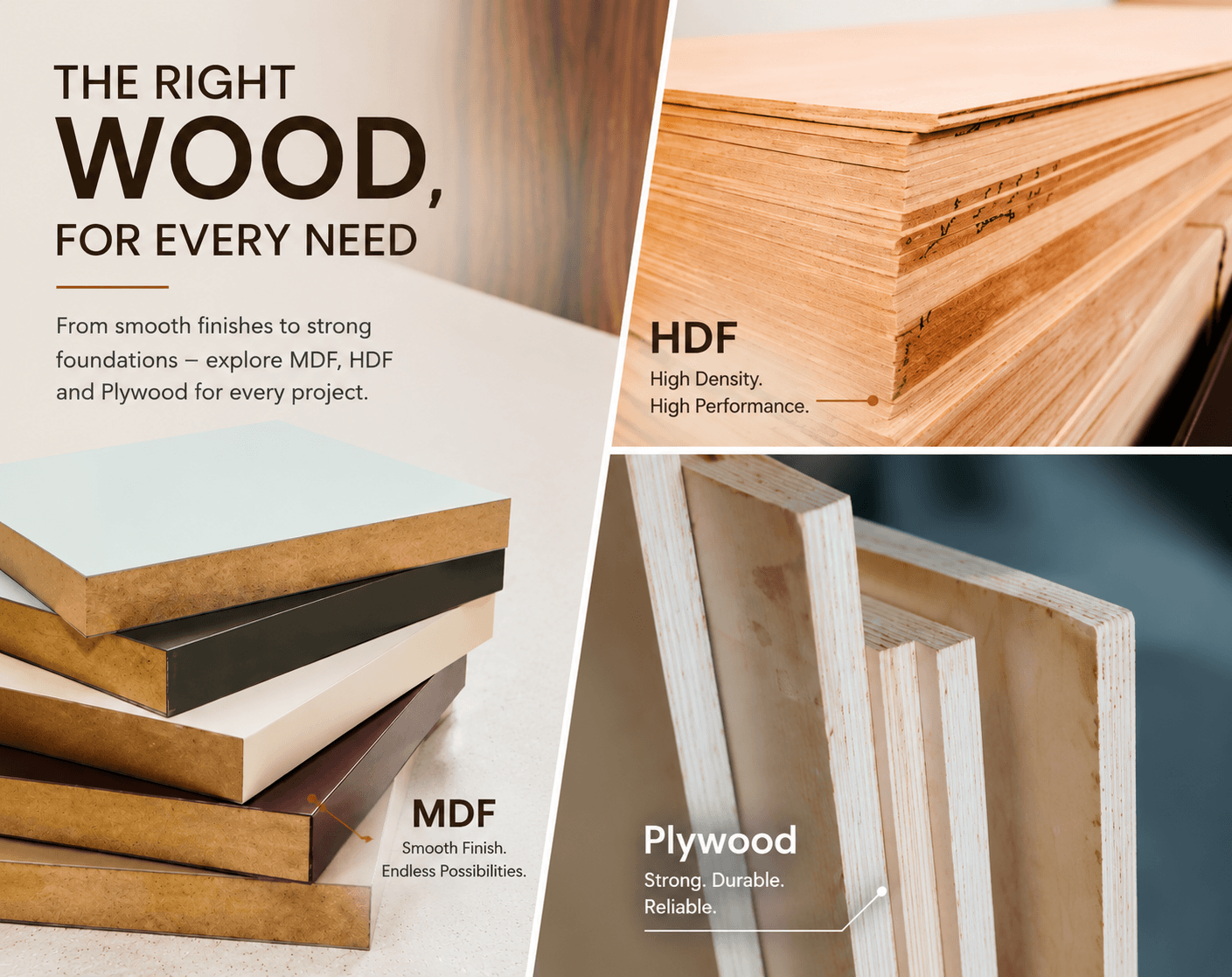
MDF (Medium Density Fibreboard) is an engineered wood product made by compressing fine wood fibres, resin, and wax under high pressure. Unlike plywood, it doesn't contain wood layers and has a smooth, uniform surface throughout.
Because of its clean finish and affordability, MDF is widely used in modern furniture, decorative panels, and modular interiors where appearance is a priority.
How MDF is Made
MDF is manufactured by breaking down wood into fine fibres, mixing them with resin and wax, and then compressing the mixture into dense boards using heat and pressure. The result is a smooth and consistent board that is easy to cut, shape, and finish.
Advantages of MDF
- Smooth Surface Finish: MDF has a very smooth surface, making it an excellent choice for paint, laminates, veneers, and decorative finishes.
- Cost-Effective: It is generally more affordable than plywood, making it a popular option for budget-friendly furniture projects.
- Easy to Shape and Design: MDF can be cut and carved easily, allowing for detailed designs and decorative patterns that are difficult to achieve with plywood.
- Uniform Structure: Since MDF has no natural wood grains or knots, it offers a consistent appearance and finish across the entire board.
Disadvantages of MDF
- Poor Water Resistance: Standard MDF can absorb moisture quickly, causing it to swell and lose its strength if exposed to water for long periods.
- Lower Screw Holding Strength: Compared to plywood, MDF does not hold screws and fittings as firmly, especially after repeated use.
- Heavy Weight: MDF is quite dense and can be heavier than plywood, making furniture more difficult to move.
- Shorter Lifespan: While MDF performs well in dry indoor spaces, it generally doesn't last as long as quality plywood, particularly in high-use areas.
Best Furniture Applications for MDF
MDF works best for:
- TV units
- Study tables
- Display shelves
- Decorative wall panels
- Bedroom furniture
- Painted furniture designs
It is a great choice when you want a smooth finish and stylish appearance without stretching your budget.
What is HDF (High Density Fibreboard)?
HDF (High Density Fibreboard) is an engineered wood product made from compressed wood fibres, similar to MDF. The key difference is that HDF is manufactured under much higher pressure, making it denser, harder, and more durable.
Thanks to its smooth surface and high strength, HDF is commonly used in furniture components, decorative panels, and premium laminated finishes.
How HDF is Manufactured
HDF is produced by converting wood into fine fibres, mixing them with resin, and compressing them under very high heat and pressure. This process creates a dense and uniform board with a hard surface and improved durability.
Advantages of HDF
- Stronger Than MDF: Due to its higher density, HDF is stronger and more resistant to dents and surface damage than standard MDF.
- Smooth Surface Finish: HDF provides an exceptionally smooth surface, making it ideal for laminates, veneers, and painted finishes.
- Better Wear Resistance: Its dense structure helps it withstand scratches and everyday wear better than MDF.
- Consistent Quality: HDF has a uniform composition throughout the board, ensuring a neat finish and reliable performance.
Disadvantages of HDF
- Limited Water Resistance: Although slightly more durable than MDF, standard HDF is still vulnerable to moisture and may swell if exposed to water for extended periods.
- Difficult to Work With: Its high density makes cutting, drilling, and shaping more challenging compared to MDF.
- Lower Screw Holding Than Plywood: HDF offers decent screw holding strength but still falls short of plywood in long-term structural applications.
- Heavy Weight: HDF is one of the heaviest furniture boards, which can make transportation and installation more difficult.
Common Uses of HDF in Furniture
HDF is commonly used for:
- Wardrobe shutters
- Cabinet doors
- Decorative wall panels
- Furniture back panels
- Laminated furniture surfaces
- Ready-to-assemble furniture
HDF is a good choice when you need a smooth, durable surface and a premium finish, but it is generally better suited for decorative applications than heavy structural furniture.
Plywood vs MDF vs HDF: Detailed Comparison
While plywood, MDF, and HDF may look similar once finished with laminates or veneers, their performance can vary significantly. Here's how they compare across the factors that matter most when choosing furniture for your home.
1. Strength Comparison: When it comes to strength, plywood leads the way. Its layered construction makes it highly durable and capable of handling heavy loads without bending or sagging. HDF offers better strength than MDF, but neither can match plywood for structural applications.
Best Choice: Plywood
2. Water Resistance Comparison: Moisture resistance is crucial, especially in Indian homes. BWR and Marine plywood are designed to withstand humidity and occasional water exposure, making them ideal for kitchens and wardrobes. MDF is the least resistant to moisture, while HDF performs slightly better.
Best Choice: BWP/Marine Plywood
3. Screw Holding Capacity: Furniture fittings rely on strong screw grip for long-term stability. Plywood holds screws securely and performs well even after years of use. HDF offers moderate performance, while MDF is more likely to loosen over time.
Best Choice: Plywood
4. Durability and Lifespan: If you're looking for furniture that lasts, plywood is the clear winner. It can easily serve for decades with proper care, while MDF and HDF generally have a shorter lifespan, especially in demanding environments.
Best Choice: Plywood
5. Weight Comparison: Despite its strength, plywood is usually lighter than MDF and HDF. This makes it easier to handle and a better option for wall-mounted or modular furniture.
Lightest Option: Plywood
6. Surface Finish Quality: MDF and HDF are known for their smooth, uniform surfaces. HDF, in particular, provides an excellent base for laminates and painted finishes, making it a preferred choice for decorative furniture.
Best Choice: HDF
7. Pest and Termite Resistance: No board is completely termite-proof, but treated plywood generally offers better protection and durability compared to MDF and HDF.
Best Choice: Treated Plywood
8. Maintenance Requirements: Laminated MDF and HDF are easy to clean and require minimal upkeep. Plywood is also easy to maintain but may need occasional refinishing depending on the surface finish.
Best Choice: MDF and HDF
9. Cost Comparison: MDF is the most affordable option, followed by HDF. Plywood costs more upfront but often provides better long-term value due to its durability and lifespan.
Most Affordable: MDF
Best Long-Term Value: Plywood
Quick Summary
- Plywood: Best for strength, durability, and moisture resistance.
- MDF: Best for budget-friendly indoor furniture.
- HDF: Best for smooth finishes and decorative applications.
For most modular furniture in Indian homes, plywood remains the most reliable all-round choice.
Which Material is Best for Different Furniture Types?
The best material depends on how and where the furniture will be used. Some furniture needs better moisture resistance, while others require a smooth finish or higher strength. Here's a quick guide to help you choose.
1. Modular Kitchen Cabinets: Kitchens face constant exposure to steam, moisture, and spills. BWR and BWP plywood offer the durability and water resistance needed for long-lasting performance.
Best Choice: BWR or BWP Plywood
2. Wardrobes: Wardrobes need strong shelves, hinges, and fittings. Plywood provides excellent strength and durability, making it a reliable choice for everyday use.
Best Choice: Plywood
3. TV Units: For modern TV units, MDF and HDF offer a smooth finish for laminates and decorative designs, while plywood can be used for structural support.
Best Choice: MDF or HDF with Plywood Support
4. Study Tables: Study tables experience daily use and need to support books, laptops, and other essentials. Plywood offers the strength and stability required for long-term use.
Best Choice: Plywood
5. Bathroom Vanities: Due to constant moisture exposure, marine plywood is the most suitable option for bathroom furniture.
Best Choice: BWP/Marine Plywood
Office Furniture: Plywood is ideal for high-use office furniture because of its durability, while MDF can be a budget-friendly option for decorative office interiors.
Best Choice: Plywood or MDF
If durability is your priority, choose plywood. If you're focused on design and budget, MDF or HDF can be suitable for specific applications.
Quick Recommendation
- Kitchen Cabinets: BWR/BWP Plywood
- Wardrobes: Plywood
- TV Units: MDF or HDF
- Study Tables: Plywood
- Bathroom Vanities: Marine Plywood
- Office Furniture: Plywood or MDF (depending on budget)
Choosing the right board for each application can significantly improve the durability, performance, and lifespan of your furniture.
Plywood vs MDF vs HDF for Indian Weather Conditions
India's climate can have a big impact on furniture, especially in areas with high humidity or heavy rainfall.