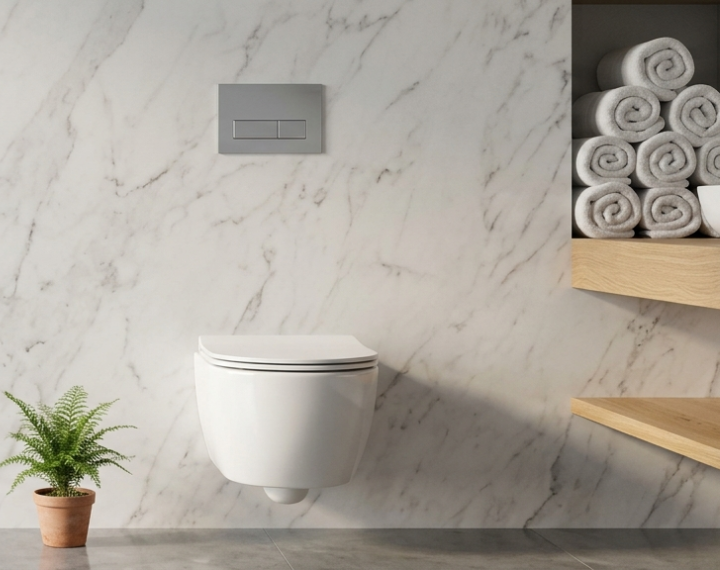
Ever notice how the smallest things in a home often affect daily comfort the most? A toilet cistern is one of those parts that usually goes unnoticed until it starts making noise, stops working properly, or doesn't fit the bathroom design.
In many homes, everything can look well planned with tiles, lighting, fittings but something still feels slightly off. Often, it comes down to a detail like a bulky cistern sitting visibly behind the toilet, disrupting the overall look.
That's why choosing the right toilet cistern isn't just a technical decision. It directly impacts space, usability, and the overall feel of the bathroom. Once you understand the basics, it becomes much easier to pick what actually suits your home.
A toilet cistern is simply the water tank connected to your toilet that stores and releases water for flushing. When you press the flush button or lever, it sends a controlled amount of water into the bowl to clear waste efficiently.
It may look like a basic component, but it plays a key role in how well your toilet performs every day. From water storage to flush strength, everything depends on how the cistern is designed and installed.
Modern cisterns are also built with efficiency in mind. Many options today help reduce water usage while still maintaining good flushing performance, which is especially important in homes where water conservation matters.
At a basic level, a toilet cistern works through a simple fill-and-release system.
Once you flush, the water stored inside the tank is released into the toilet bowl. This sudden flow creates the pressure needed to clear waste. After that, the empty cistern automatically starts refilling through a connected water supply.
Inside the tank, a few small parts handle this process:
The float rises as the tank fills and signals when to stop the water supply. Then it resets after every flush, ready for the next use.
It's a simple cycle, but when everything works properly, it ensures smooth flushing, consistent water flow, and no unnecessary wastage.
When it comes to types of toilet cisterns, there isn't a one-size-fits-all option. The right choice usually depends on bathroom space, plumbing layout, budget, and the kind of finish you want.
Let's go through the main ones you'll commonly see in Indian homes and modern projects.
This is the most familiar design, where the cistern sits directly on top of the toilet pan, forming a single unit.
It's widely used because it's simple, cost-effective, and easy to maintain. Plumbers are very comfortable working with it, and spare parts are easily available almost everywhere.
A concealed toilet cistern is hidden inside the wall, with only a flush plate visible outside.
It gives a clean, modern look and helps save visual space, which is why it's often chosen for contemporary bathrooms. However, it requires proper planning during construction since access for repairs is behind the wall.
In this setup, the toilet bowl is mounted on the wall, and the cistern is hidden within a frame system inside the wall.
It creates a floating effect and makes floor cleaning easier. But it needs strong wall support and careful installation, especially in residential buildings.
This is a more traditional style where the tank is installed high on the wall and connected with a long flush pipe.
It relies on gravity for flushing and is mostly seen in older or heritage-style bathrooms today.
Here, the cistern is fixed just above the toilet pan and connected with a short pipe.
It offers a balance between old and modern designs and is still used in some practical, no-frills bathroom setups.
A dual flush system gives two options — half flush for liquid waste and full flush for solid waste.
It's not a separate design but a feature added to most modern cisterns, helping reduce water usage significantly, which is especially useful in Indian households.
This is a common comparison, and the right choice really depends on what matters more in your bathroom — convenience or aesthetics.
A practical and widely used option where the cistern is fixed directly on top of the toilet pan.
Why choose it:
Best for: Everyday homes where functionality and budget are key priorities.
A modern system where the concealed toilet cistern is hidden inside the wall, leaving only the flush plate visible.
Why choose it:
Points to consider:
Best for: Modern interiors where design and a clutter-free look are important.
The material of a toilet cistern might not seem like a big deal at first, but it plays a major role in durability, maintenance, and long-term performance.
Ceramic is the most commonly used material in residential bathrooms.
Why it works well:
Things to keep in mind:
Best for: Most Indian homes looking for a reliable and familiar option.
These are lightweight cisterns often used in modern and concealed setups.
Why people choose it:
Things to keep in mind:
Best for: Concealed systems and budget-conscious installations.
Less common in homes but widely used in commercial or high-traffic areas.
Why it stands out:
Things to keep in mind:
Best for: Public spaces, commercial buildings, and heavy-use environments.
There isn't a single answer here because Indian homes vary a lot — from compact city apartments to larger independent houses. The right choice depends mainly on space, water conditions, and how much maintenance convenience you want.
For most standard homes, a close-coupled cistern works well. It's practical, easy to repair, and parts are available almost everywhere, which matters a lot in day-to-day use.
In modern apartments and newly built homes, many people now prefer a concealed toilet cistern. It gives a cleaner look and helps make smaller bathrooms feel more open. However, it should ideally be planned during construction so that installation and servicing are properly managed.
When it comes to functionality, dual flush systems are becoming the norm across both options. They help reduce water usage, which is especially useful in cities where water conservation is important.
Simple takeaway:
Choosing a toilet cistern becomes much easier when you break it down into a few practical points instead of focusing only on design or price.
Even a well-installed cistern can develop issues over time, especially with regular daily use. Most problems are not serious at first, but they should be addressed early to avoid water wastage or inconvenience.
A toilet cistern may not be the most visible part of a bathroom, but it plays an important role in everyday comfort, efficiency, and water usage. Whether it's a simple close-coupled design or a modern concealed system, the right choice always depends on your space and practical needs.
At Ganpati Homez, we understand these small but important details. As a trusted sanitaryware store in Bhubaneswar, located in Laxmisagar, we offer a wide range of toilet cisterns to suit different bathroom styles and budgets. Our team can help you choose the right concealed system for your home, from basic to modern.
If you're planning a bathroom upgrade or building a new space, we're here to guide you with practical advice and reliable products that make everyday use smoother and hassle-free.